
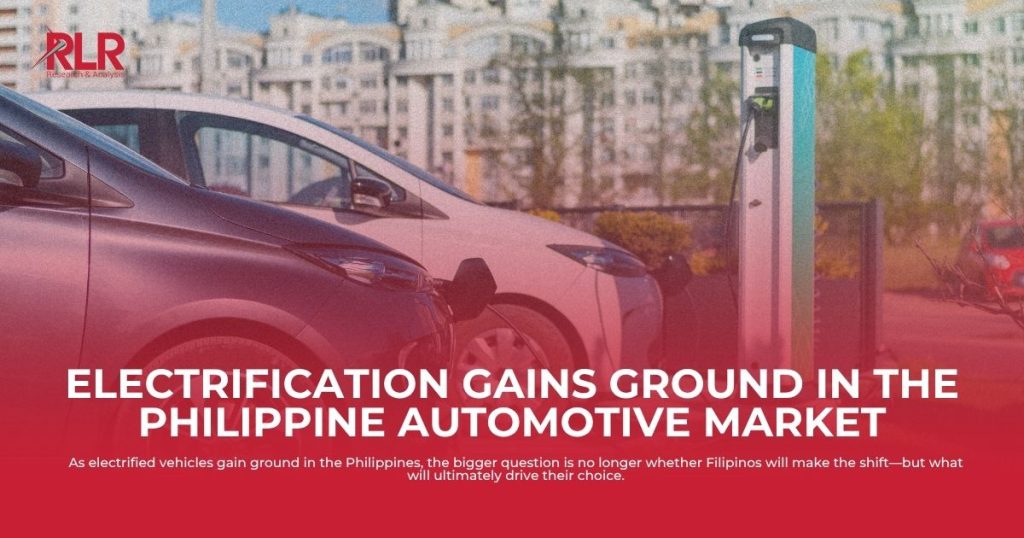
Electrification is becoming a bigger part of the Philippine automotive market.
Electric vehicles (EVs) come in several forms. Battery electric vehicles (BEVs) run entirely on electricity, while hybrid electric vehicles (HEVs) combine electric propulsion with an internal combustion engine. Plug-in hybrid electric vehicles (PHEVs) also use both, but their batteries can be charged from an external power source.1
In 2022, the Electric Vehicle Industry Development Act (EVIDA) established a national framework for developing the country’s EV industry. The law covers areas such as EV adoption, charging infrastructure, manufacturing, and incentives.1
Adoption remained limited in the years immediately following EVIDA. In 2023, the Department of Energy (DOE) still described the Philippine EV sector as being in the “early stages of development.” By the end of that year, only 1,359 electric and 6,155 hybrid vehicles were registered nationwide.2,3
In 2025, the DOE further harmonized its EV recognition guidelines, establishing a consistent classification system across different EV technologies and streamlining industry processes. The updated guidelines cover BEVs, HEVs, PHEVs, light electric vehicles (LEVs), range-extended electric vehicles (REEVs), and fuel cell electric vehicles (FCEVs).4
A Changing Case for Electrification
Cost has become a bigger consideration in vehicle ownership.
Fuel prices, in particular, have shown how quickly operating costs can change when global oil markets become volatile.
This was evident in vehicle sales in 2026. Higher pump prices amid geopolitical tensions in the Middle East affected vehicle-buying behavior, according to the Chamber of Automotive Manufacturers of the Philippines, Inc. (CAMPI). In April, overall vehicle sales fell 18.9% year-on-year, while electrified vehicle sales rose 288% to 5,855 units. CAMPI linked the stronger demand for electrified and fuel-efficient vehicles partly to buyers becoming more conscious of practicality as fuel prices increased.5
Rising fuel costs give consumers another reason to consider electrified vehicles. Environmental concerns may appeal to some, while fuel efficiency, operating costs, technology, or using less gasoline may matter more to others.
More Brands, More Electrified Choices
The Philippine automotive market now offers considerably more electrified choices than it did only a few years ago.
Omoda & Jaecoo formally entered the Philippine market in 2025 with three battery-electric models and plans to expand its dealership network.6 BYD has also continued to broaden its local presence following strong sales of its electrified vehicles, recording 26,122 retail sales in 2025.7
Tesla began vehicle sales in the Philippines in 2024, bringing the Model 3 and Model Y directly into the local market.
Japanese automakers have also expanded their electrified lineups. Toyota, which introduced the Prius hybrid to the Philippines as early as 2009, has steadily added HEVs across several vehicle segments. It launched its first Toyota-branded BEV in the country, the bZ4X, in December 2025 and has since added more hybrid and battery-electric models to its local portfolio.8
Consumers are no longer choosing simply between a conventional vehicle and an electrified one. They also have to consider different types of electrification, brands, vehicle categories, and price points.
Electrified Vehicles Are Gaining Ground
Data from the Philippine Statistics Authority show that registered electric vehicles increased from 1,359 in 2023 to 6,697 in 2024. Hybrid registrations rose from 6,155 to 17,590 over the same period.3
The upward trend continued in 2025. From January to July alone, 29,715 EVs were registered with the Land Transportation Office (LTO), already exceeding the 24,286 registrations recorded for the whole of 2024. EVs accounted for nearly 5% of new vehicle registrations during the period, with the DOE describing this as a threefold increase since 2023.4
The contrast became more pronounced in 2026. CAMPI and the Truck Manufacturers Association (TMA) reported total vehicle sales of 204,557 units in the first six months of the year, down 11.4% from 230,912 during the same period in 2025. In June alone, however, electrified vehicle sales reached 6,995 units, with BEVs, HEVs, and PHEVs together accounting for 28% of vehicle sales for the month.9,10
The trend continued into July. From January to July 2026, CAMPI-TMA vehicle sales reached 241,725 units, down 10% year-on-year. Over the same period, electrified vehicle sales rose 136% to 38,286 units from 16,195 a year earlier. HEVs accounted for 20,716 units, while BEV sales reached 10,476 and PHEV sales reached 7,094.11
In July alone, CAMPI-TMA members sold 7,086 electrified vehicles, up 162% from 2,707 units in July 2025. Electrified vehicles accounted for 29.5% of vehicle sales during the month.11
Conventional vehicles still dominate the country’s vehicle population. Gasoline-powered vehicles accounted for 78.7% of registered vehicles in 2024. But recent sales figures show that electrified vehicles are gaining ground even while the wider automotive market is experiencing weaker sales.3,9,11
The EV Ecosystem Is Catching Up
EVIDA created the framework for expanding EV charging infrastructure and required certain establishments to provide dedicated EV parking and charging facilities.1 Since then, charging has become more visible at commercial establishments, dealerships, and along key routes.
The country had 912 publicly accessible charging stations in March 2025, with the network continuing to grow as more providers entered the market.12
Measures introduced under EVIDA and subsequent policies have included tax and other fiscal incentives for EVs and EV-related activities. The law also provides for incentives aimed at encouraging local EV manufacturing, charging infrastructure, and investment.1
Charging facilities are being installed at selected dealerships, while brands entering or expanding in the country are building dealer and service networks alongside their vehicle offerings. Toyota, for example, has installed charging stations at selected dealerships in Metro Manila and Metro Cebu, with plans to expand to other areas.8
For consumers, some of the practical barriers to owning an EV are beginning to ease.
More Choices Bring New Questions
A buyer considering an electrified vehicle can now choose among BEVs, HEVs, and PHEVs from a growing number of manufacturers. Having more options, however, can make the purchase decision more complex.
Price, fuel savings, charging access, range, brand reputation, vehicle size, technology, after-sales support, and familiarity with electrification can all come into play. One consumer may ultimately choose an HEV, while another may be comfortable moving directly from a conventional vehicle to a BEV.
Knowing that EV sales are growing is useful. Knowing why consumers are choosing them—and what they are choosing between—is another matter.
Which brands are consumers considering? Which vehicle attributes carry the most weight in the purchase decision? What concerns prevent interested buyers from making the switch? How do consumers decide between an HEV, PHEV, and BEV?
For those who have already made the shift, the questions are different. What convinced them to buy an electrified vehicle? Why did they choose one type over another? Which considerations mattered most? And after living with the vehicle, has the experience met their expectations?
Understanding the Consumer Behind the Shift
As more brands and models compete for buyers, manufacturers and marketers need to understand what is actually driving consumer choice.
Research can identify what consumers are looking for, which brands make it into their consideration set, and which attributes ultimately influence the purchase. It can also show whether the factors that attract consumers to EVs are the same ones that eventually drive purchase.
Existing owners offer another source of insight. Their reasons for adopting, the factors that influenced their choice of vehicle and powertrain, experience after purchase, satisfaction, and willingness to buy or recommend an EV again can show how ownership compares with their expectations.
The next wave of EV buyers may have different priorities, concerns, and expectations from those who adopted the technology early.
Automotive is one of the research specializations of RLR Research & Analysis. Through quantitative and qualitative research, RLR can examine the factors behind EV consideration and purchase, brand consideration, perceptions of BEVs, HEVs, and PHEVs, and the experiences of existing owners.
The Philippine EV market is no longer defined by a lack of options. The next challenge is understanding which of those options Filipino consumers will choose—and why.
If your organization wants to better understand the Filipino EV consumer, get in touch with RLR Research & Analysis by sending us an email or filling out our quotation request form to discuss your research needs.
Resources
- Rep. Act No. 11697. (2022). ↩︎
- Department of Energy, Guidelines on the electric vehicle (EV) recognition and adoption of EV standard classification on road transport for incentive eligibility pursuant to the Electric Vehicle Industry Development Act (EVIDA), DOE Department Circular No. DC2023-05-0012 (May 12, 2023). ↩︎
- Philippine Statistics Authority. “Number of Registered Electric Vehicles Increased Almost Fivefold in 2024.” Philippine Statistics Authority. Accessed August 28, 2026. https://psa.gov.ph/content/number-registered-electric-vehicles-increased-almost-fivefold-2024/ ↩︎
- Department of Energy. “DOE harmonizes electric vehicle recognition guidelines to streamline industry processes and support EV adoption.” Philippine Information Agency. Accessed August 28, 2026. https://pia.gov.ph/press-release/doe-harmonizes-electric-vehicle-recognition-guidelines-to-streamline-industry-processes-and-support-ev-adoption/ ↩︎
- Zapanta, Logal Kal-El M. “PH car sales drop 19% in April as Mideast crisis tempers demand.” Inquirer. Accessed August 28, 2026. https://business.inquirer.net/592076/ph-car-sales-drop-19-in-april-as-mideast-crisis-tempers-demand/ ↩︎
- Crismundo, Kris. “Chinese EV brand to open 24 dealerships in PH in 2025.” Inquirer. Accessed August 28, 2026. https://business.inquirer.net/507234/chinese-ev-brand-to-open-24-dealerships-in-ph-in-2025 ↩︎
- BYD Cars Philippines. “BYD Cars Philippines Achieves Record Sales in 2025; Renews Distributorship with ACMobility.” BYD Cars Philippines. Last modified August 19, 2026. https://bydcarsphilippines.com/blog/byd-record-sales-2025-renews-distributor/ ↩︎
- Toyota Motors Philippines. “FEARLESS ENERGY, MULTIPLE POSSIBILITIES: Toyota Motor Philippines officially launches bZ4X BEV.” Toyota Motors Philippines. Accessed August 28, 2026. https://www.toyota.com.ph/news/toyota-motor-philippines-officially-launches-bz4x-bev/ ↩︎
- Zapanta, Logan Kal-El M. “Philippine auto sales down 11% in H1.” Inquirer. Accessed August 28, 2026. https://business.inquirer.net/601827/philippine-auto-sales-down-11-in-h1/ ↩︎
- Villanueva, Joann. “Auto industry group sees hike in car sales for second half of 2026.” Philippine News Agency. Accessed August 28, 2026. https://www.pna.gov.ph/articles/1280102/ ↩︎
- Zapanta, Logan Kal-El M. “EVs continue to defy auto sales downturn.” Inquirer. Accessed August 28, 2026. https://business.inquirer.net/607548/evs-continue-to-defy-auto-sales-downturn/ ↩︎
- Department of Energy. “PH expands EV charging infrastructure with stronger regulations and public consultation drives.” Philippine Information Agency. Accessed August 28, 2026. https://pia.gov.ph/news/ph-expands-ev-charging-infrastructure-with-stronger-regulations-and-public-consultation-drives/ ↩︎
